When scientists discover a planet in our Milky Way that is made of diamonds (Bailes et al. 2011), public fascination and admiration are virtually assured. Who would not revel in the idea that we might spot a particularly bright sparkle in the night sky? However, when scientists discover that burning fossil fuels causes climate change, or that a lethal airborne virus is best controlled through mask wearing and social distancing, then the public and political response is much less favorable, with scientists being verbally assaulted or having their reputations impugned (Lewandowsky, Mann et al. 2016; Mann 2012).
Scientists cannot escape those politically motivated conflicts. Daniel Kahneman has recommended that scientists should scrupulously avoid the political and that if science involves a matter “that anybody in Congress is going to be offended by, then it’s political” (cited in Basken 2016). Adherence to Kahneman’s recommendation would render entire scientific fields, such as evolutionary biology and climate science, off limits. Moreover, even if scientists abstain from providing policy advice, they can become targets of conspiracy theorists who frequently “blame the messenger” for inconvenient information, as has been apparent during the COVID-19 pandemic. For example, Dr. Anthony Fauci, the director of the National Institute of Allergy and Infectious Diseases, has been subject to extensive online abuse and hate speech.1 If political conflict cannot be avoided, scientists must manage such conflicts, and the public must understand that such conflicts can be inevitable. Fortunately, both surveys (Pew Research Center 2009) and experimental studies (Kotcher et al. 2017) have shown that scientists can, in some circumstances, advocate policies without necessarily losing credibility or the public’s trust.
In this article, we explore the common attributes of political conflicts in which scientific findings take center stage, using the COVID-19 pandemic as a case study, but also drawing on knowledge of long-standing conflicts surrounding climate change and vaccinations. A core to all those conflicts is disinformation, mainly crafted by politically motivated actors, that distorts public perception of scientific evidence. Another core attribute of such conflicts in democratic societies is the public’s legitimate need to be involved in the surrounding policy debates and for dissenting voices to be heard. The fundamental question to be resolved, therefore, is how to differentiate between legitimate democratic critique of scientifically informed policies on one hand and motivated science denial on the other.
We explore the common attributes of political conflicts in which scientific findings have a central role, using the COVID-19 pandemic as a case study, but also drawing on long-standing conflicts over climate change and vaccinations. We analyze situations in which the systematic spread of disinformation or conspiracy theories undermines public trust in the work of scientists and prevents policy from being informed by the best available evidence. We also examine instances in which public opposition to scientifically grounded policy arises from legitimate value judgments and lived experience. We argue for the public benefit of quick identification of politically motivated science denial, and inoculation of the public against its ill effects.

An important item at Our World in Data:
Humans have been reshaping the planet’s land for millennia by clearing wilderness to grow crops and raise livestock. As a result, humans have destroyed one-third of the world’s forests and two-thirds of wild grasslands since the end of the last ice age.
This has come at a huge cost to the planet’s biodiversity. In the last 50,000 years – and as humans settled in regions around the world – wild mammal biomass has declined by 85%.
Expanding agriculture has been the biggest driver of the destruction of the world’s wilderness.
This expansion of agricultural land has now come to an end. After millennia, we have passed the peak, and in recent years global agricultural land use has declined...more at link


Gene Drive and Its Different Forms
Gene drive is loosely referred to as “a phenomenon whereby a particular heritable element biases inheritance in its favor, resulting in the gene becoming more prevalent in the population over successive generations” according to an article published in 2020 by the Proceedings of the National Academy of Sciences. Those involved in gene drive research have emphasized the need to clarify the terms pertaining to the technology to avoid the risk of hampering the field, confusing the public, and possibly losing a technology that may help solve some of the world’s most intractable problems in public health, conservation, and food security.
Dr. Alekos Simoni, Scientific Manager at the Polo Genomics, Genetics, Biology and a member of the Target Malaria consortium, further breaks down the definition of gene drive:
According to Dr. Simoni, there are different types of gene drives, and here are some examples:


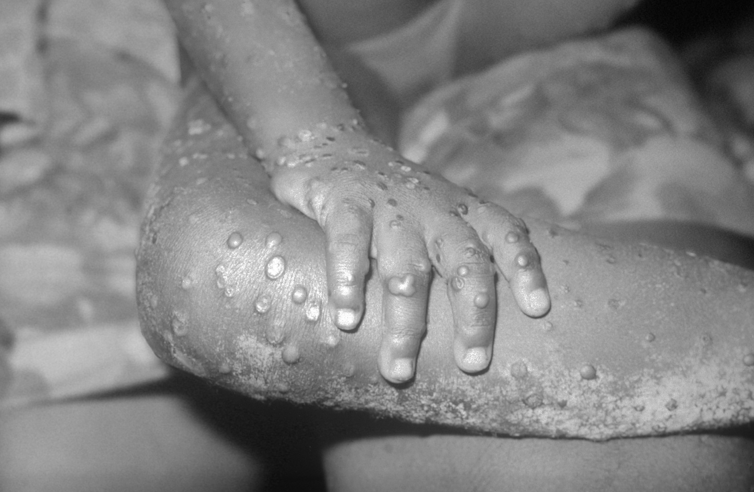
Two cases of monkeypox have been detected in Australia, following reported cases in several European countries. Both are in men just returned from Europe.
Health authorities have said the cases are not a cause for panic, but to remain vigilant for symptoms if you have just returned from overseas.
Monkeypox is caused by an orthopoxvirus that is closely related to the virus that caused smallpox, variola. Smallpox only infected humans, but monkeypox is an animal virus that occasionally infects humans after they are bitten or scratched by a monkey or other animal.
It is a respiratory virus and can also spread to humans without contact, probably through aerosols. However, it does not usually spread easily between humans, and typically only in close contacts. Studies have found about 3% of contacts of a monkeypox case will be infected.
A week or two after exposure, infection starts with fever, headache, swelling of the lymph nodes and muscle ache. Skin eruptions usually appear within one to three days of the fever commencing, and in most cases affect the face, hands and feet.
There are two types of the virus, one which has a fatality rate of about 1% and one with a fatality rate of about 10%. The UK outbreak outbreak appears to be the less severe type, but 1% is similar to the fatality rate for COVID, so it is still a concern. It is more severe in children.
It was first identified in humans in 1970, in the Democratic Republic of Congo (DRC). It is a re-emerging disease that’s been causing large outbreaks in Nigeria and DRC since 2017.
Scientists have puzzled over why a previously rare infection is now becoming more common. The vaccine against smallpox also protects against monkeypox, so in the past, mass vaccination against smallpox protected people from monkeypox too. It is 40 years since smallpox was declared eradicated, and most mass vaccination programs ceased in the 1970s, so few people aged under 50 have been vaccinated.
There are even fewer in Australia, where mass smallpox vaccination was never used, and an estimated 10% of Australians have been vaccinated. The vaccine gives immunity for anything from five to 20 years or more, but may wane at a rate of about 1-2% a year.
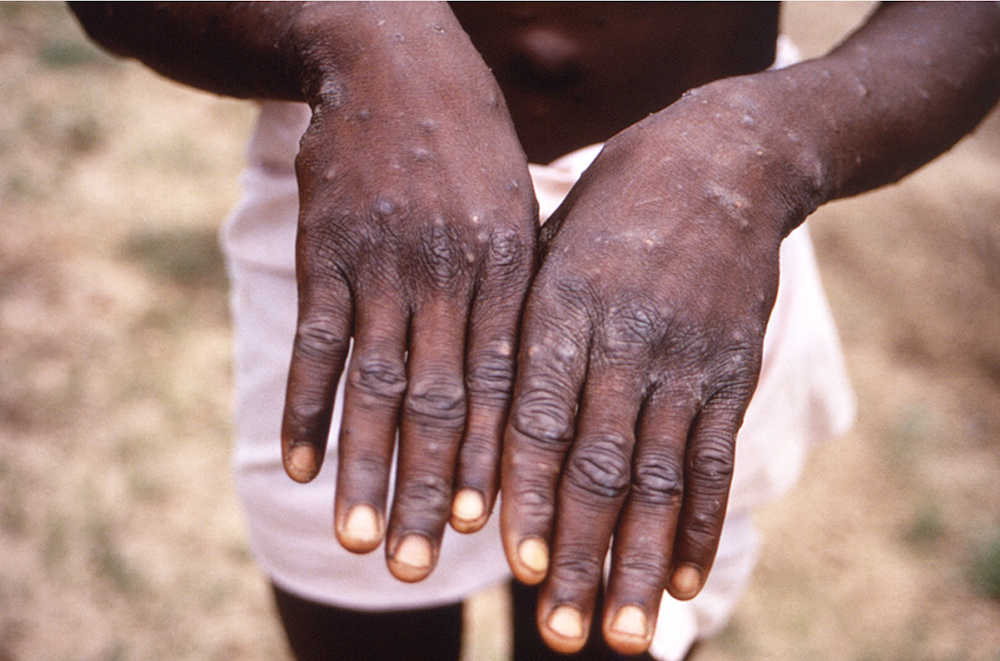
Our research shows waning of immunity from smallpox vaccination may explain the increasing outbreaks of monkeypox – it is more than 40-50 years since mass vaccination ceased.
In September 2018, a case of monkeypox occurred at a naval base in Cornwall, UK, in a person who had travelled from Nigeria. Simultaneously, a second case occurred in Blackpool in an unrelated person returning from Nigeria, and a nurse also became infected in the hospital.
In the current outbreak, the first case in the UK had travelled from Nigeria, where there have been over 500 cases and 8 deaths since 2017.
The current outbreak in the UK is the largest outside of Africa and has spread to many countries in Europe, North America and now Australia.
Clusters have occurred among men who have sex with men, a pattern not seen before. The initial importation could have spread at a venue or within a community that resulted in more spread in the same group.
This is an unusual outbreak, with unrelated cases in different locations in the UK. This could be explained by substantial numbers of asymptomatic infection, but asymtomatic infection is uncommon and usually in people who have had the smallpox vaccine.
In a well-studied outbreak in the US linked to imported animals, only three in 20 cases were asymptomatic, and they had been vaccinated. The other 17 cases all had the rash.
Most people infected in the current epidemic are too young to have been vaccinated, so substantial asymptomatic infection is unlikely. Further, smallpox does not transmit in asymptomatic people, so it is unlikely monkeypox will be very different.
Serological studies to measure asymptomatic infection are being done in the UK and should shed more light on this hypothesis. Hopefully further investigations can help us understand the epidemiologic links between cases in the UK and elsewhere.
This is the first time there has been travel-related spread from outside of the African continent, where the virus is endemic in animals. There have been a number of travel related importations to the UK, Singapore, Israel and other countries from Nigeria and DRC since 2017, but now the source of spread appears to be the UK, which is unprecedented. Given visits between the UK and Australia are very common, it is not surprising we now have cases here.
There are effective vaccines against monkeypox – the second and third generation smallpox vaccines, both live virus vaccines using the vaccinia virus. Vaccinia is another orthopoxvirus that confers immunity against smallpox and monkeypox, but can have serious side effects in some people, especially those with compromised immune systems.
Mass vaccination would not be warranted because of the side effects. The best strategy is to identify contacts and vaccinate them, rather than mass vaccination.
This is called “ring vaccination” and was used to eradicate smallpox. Monkeypox has a long incubation period (one to two weeks), so being vaccinated post-exposure can protect.
The third generation vaccines do not replicate in the body and can be used in immunocompromised people. However they are expensive and it’s unlikely Australia would have much supply. For health workers who will be at risk of exposure, the use of third generation vaccines should be considered if the epidemic grows.
There are also effective antivirals against monkeypox and smallpox which were not available before smallpox was eradicated.
Given the unusual nature of this epidemic, it would be wise to ensure we have a stockpile of antivirals and enough of both types of vaccines, together with regulatory processes to use them against monkeypox.
Isolation of cases and quarantine of contacts works to curtail epidemics. We would also do well to draw on the contact tracing infrastructure developed during COVID, so contacts can be rapidly identified and quarantined, and the spread of the virus curtailed.
C Raina MacIntyre, Professor of Global Biosecurity, NHMRC Principal Research Fellow, Head, Biosecurity Program, Kirby Institute, UNSW Sydney
This article is republished from The Conversation under a Creative Commons license. Read the original article.

Margaret Hellard, Burnet Institute; Brendan Crabb, Burnet Institute; Dominic Delport, Burnet Institute, and Nick Scott, Burnet Institute
Australia’s COVID death toll is rising, yet public health measures to reduce transmission such as mask mandates are largely a thing of the past.
It’s time for governments and the community to consider what measures can be reintroduced to reduce COVID transmission and deaths, particularly during waves of infection.
Cutting COVID transmission by 20% could avert more than one million infections and 500 COVID deaths in Victoria this year, our new modelling shows.
Given Victoria makes up around 25% of Australia’s population, if extrapolated, these results suggest a 20% reduction in transmission could save up to 2,000 lives nationally.
Even if reintroducing public health measures cut COVID transmission by 10%, this could save between 198 and 314 Victorian lives between now and the end of 2022. Again, this would translate to many more lives saved nationally.
The prevailing view in Australia is we can now treat COVID “like the flu”. However, the dramatic and sustained increase in COVID-related deaths in 2022 tells a very different story. There have been 5,687 COVID deaths reported in Australia since January 1.
During the Omicron wave in January 2022, COVID was the second most common cause of death nationwide, with 2,865 more people dying in that month than is normally expected. That’s a 22% increase.
Critically, COVID deaths have not stopped since the January peak: our current seven-day average sits at about 45 deaths per day, or 315 deaths each week.
In comparison, our most recent severe influenza season (2017) caused 1,255 deaths across the entire year.
There are still so many deaths because we have let the virus run. By scaling back public health measures and delivering an “it’s over” message, we have allowed almost unfettered transmission.
Currently, 381,000 Australians are known to be infected with SARS-CoV-2, the virus that causes COVID. With high case numbers comes a high death toll, even with a reduced case fatality rate (the proportion of those infected who die).
This relaxed policy stance – combined with emerging variants (three new Omicron strains have entered Australia), winter encouraging more time indoors, and waning immunity – suggest high caseloads will continue for some time yet.
In order to reduce COVID deaths, it’s important to understand who is dying and why. While some basic information on deaths is available for some states, additional data – for example, whether those who die are eligible for antiviral treatment – is needed. Such data could enable targeted public health action such as improving treatment access.
Nevertheless, with the data we have we know older people continue to be at greatest risk. Last week in NSW, 41% of all COVID deaths were in aged care residents, despite very high rates of vaccination.
We often hear those who die from COVID have pre-existing medical conditions. This is true – about 70% of deaths due to COVID were in people with chronic conditions.
But note that half of all Australians have a chronic condition, as do 80% of those aged 65 and older. Given most of those who have died due to COVID are aged over 65, it’s not surprising most also have an underlying condition.
Some argue the high rates of COVID deaths isn’t as worrying as it seems because people are dying “with” COVID rather than “from” COVID.
But the majority (89.8%) of COVID deaths are “from” COVID.
For those defined as dying “with” COVID, this means COVID has possibly or probably “contributed” to those deaths.
For example, a person is infected with COVID which weakens their immune system and leads to a bloodstream infection (sepsis). They’re hospitalised and die three weeks after their COVID diagnosis. Although their death is directly “due to” sepsis, it is also “with” COVID because COVID caused the decline in their health which ultimately led to their death. COVID is not incidental in these deaths.
COVID is also killing young people – even children. Eight children aged nine and under have died in Australia from COVID since the pandemic began, as well as five people aged ten to 19 years, 22 in their twenties, and 65 in their thirties.
It’s impossible to know if COVID will cause significant numbers of premature death in coming years. Given the damage the SARS-CoV-2 virus causes to the heart, brain, kidneys and lungs, we have reason enough to be seriously concerned.
Vaccination continues to be hugely important, and the main reason we can even contemplate our current open lifestyle. But vaccination alone is not enough.
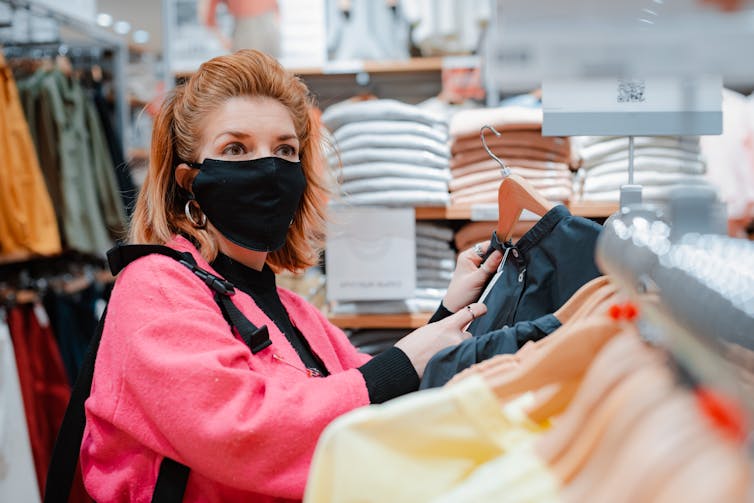
Improving air quality and/or wearing a high-quality N95/P2 mask in indoor spaces cause minimal disruption to the community but interrupt COVID transmission effectively.
To illustrate the benefit of interventions, we used our model to simulate three hypothetical scenarios for the state of Victoria for the remainder of 2022.
We first modelled a scenario with no additional interventions (the light blue line). We compared this with two scenarios where, from May 20, hypothetical interventions were introduced that could reduce the risk of transmission per contact by 10% (the dark blue line) or 20% (the red line).
We didn’t specify which specific interventions should be adopted to make up the 10% or 20% reduction. It could be a single intervention a or combination that make up the 10% to 20% reduction.
Between May 20 and the end of 2022, the outcomes from the “no additional intervention” scenario were an extra 2.22-2.38 million infections or reinfections and 1,060-1,450 deaths in Victoria.
With interventions reducing transmission by 10%, 596,000-614,000 infections and 198–314 deaths could be averted (a 16-25% reduction) over this period.
With interventions reducing transmission by 20%, 1.08-1.10 million infections and 462-502 deaths could be averted (a 37-40% reduction). As outlined above, this translates to up to 2000 lives nationally.
These are likely to underestimate the impact of interventions because the analysis was deliberately conservative and didn’t consider new COVID variants or sub-variants (only omicron BA.1 and BA.2).
The simple message is a small reduction in transmission has a big impact on mortality.
The model used for this work was COVASIM, a model that can assess the impact of different policies and behaviours on COVID transmission, hospitalisations and deaths. The model has been used to assist policy decisions in Australia, the United States and the United Kingdom.
People in the model are assigned an age (which affects their susceptibility to infection and their disease prognosis), a household, a school (for people aged five to 17) or a workplace (for people over 18, up to 65), and they participate in a number of community activities that may include attending restaurants, pubs, places of worship, community sport, and social gatherings.
The model includes:
Australia successfully mitigated the direct impact of COVID in the first two years of the pandemic. However, recently Australia has made little effort to reduce the impact of COVID. We are quietly, perhaps unknowingly, approving a trade-off between COVID deaths, and economic and social well-being more generally.
Many people seem unaware of the high death numbers, and that simple interventions can make a meaningful difference.
But the value of the current trade-off is unclear. The economic and social benefits of winding back key public health measures, when tens of thousands of COVID cases occur each day, have not been established. Indeed, stories of major COVID-driven disruption are common, suggesting the opposite is true.
Australia must find a middle road, centred around slowing transmission, reinvigorating vaccine roll-out and scaling-up treatment options for people with COVID infections. Otherwise, 10,000 or more COVID deaths per year could well be our new – previously unthinkable – normal.
Margaret Hellard, Deputy Director (Programs), Burnet Institute; Brendan Crabb, Director and CEO, Burnet Institute; Dominic Delport, Health modeller, Burnet Institute, and Nick Scott, Econometrician, Burnet Institute
This article is republished from The Conversation under a Creative Commons license. Read the original article.
Maize varieties for sustainable food production systems
The approved field trials will be conducted in close collaboration with the Flanders Research Institute for Agriculture, Fisheries and Food (ILVO) and are part of research projects running at the VIB-UGent Center for Plant Systems Biology: the group of Prof. Hilde Nelissen, who aims for maize varieties that are more resistant to prolonged periods of drought; the lab of Prof. Lieven De Veylder investigates how to increase stress-resilience when the plants experience DNA-damage caused by environmental conditions; and research done by the team of Prof. Wout Boerjan in developing better digestible plants and plant-based products to support a bio-based economy.

The field trials will be performed over a three-year time period. The maize plants in these studies are generated via the precision breeding technique CRISPR-Cas9, which allows targeted modifications in the plant’s genetic material. By means of field trials, the effect of the genetic alterations on the complete life cycle of the plant can be estimated, in real agricultural growth conditions. The trials were authorized by three federal ministers for Health, Environment, and Agriculture after favorable opinions from the Biosafety Advisory Council. Having access to precision breeding methods based on genome editing is considered to be very important for the future of agriculture, as it can speed up the development of crops with climate resistance or other characteristics that improve the sustainability of our food systems

Horizontal gene transfer (HGT) enables the acquisition of novel traits via non-Mendelian inheritance of genetic material. HGT plays a prominent role in the evolution of prokaryotes, whereas in animals, HGT is rare and its functional significance is often uncertain. Here, we investigate horizontally acquired cellulase genes in the free-living nematode model organism Pristionchus pacificus. We show that these cellulase genes 1) are likely of eukaryotic origin, 2) are expressed, 3) have protein products that are secreted and functional, and 4) result in endo-cellulase activity. Using CRISPR/Cas9, we generated an octuple cellulase mutant, which lacks all eight cellulase genes and cellulase activity altogether. Nonetheless, this cellulase-null mutant is viable and therefore allows a detailed analysis of a gene family that was horizontally acquired. We show that the octuple cellulase mutant has associated fitness costs with reduced fecundity and slower developmental speed. Furthermore, by using various Escherichia coli K-12 strains as a model for cellulosic biofilms, we demonstrate that cellulases facilitate the procurement of nutrients from bacterial biofilms. Together, our analysis of cellulases in Pristionchus provides comprehensive evidence from biochemistry, genetics, and phylogeny, which supports the integration of horizontally acquired genes into the complex life history strategy of this soil nematode.